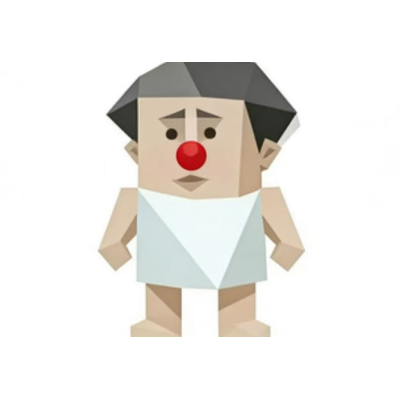
Turns out we're all clowns in the end.
JOKE-R — The Clown: Complete SBTI Personality Guide
Backstage Diary: Behind the Circus Curtain
*Found in a dressing room drawer, underneath a pile of confetti and a dried-out tube of greasepaint. The first half of the notebook is filled with joke drafts, crowd-work notes, and doodles. The second half is different. The handwriting gets smaller. The margins get wider. The jokes stop.*
Before the Show
Three bulbs in the mirror. One of them flickers.
I sit in front of it with a sponge and a palette of colors that don't exist in nature and begin the transformation. Layer one: concealer. Not the cosmetic kind — the psychological kind. Cover the circles under the eyes. Cover the evidence of the 3 AM ceiling-staring session. Cover the face that isn't ready to be seen.
Layer two: the base. White. A blank slate. Erase whatever expression was there before and replace it with something neutral, something moldable, something that can become anything the room needs.
Layer three: the smile. Red. Wide. Curved up past the cheekbones. Three times bigger than a real smile, because a real smile isn't big enough for what I need it to do.
Three layers and the person in the mirror isn't me anymore. It's the other one. The one they like. The one who's always up for it. The one who walks into a room and immediately starts scanning for tension, for awkward silences, for any gap in the atmosphere that needs filling — and fills it. With a joke. With a voice. With whatever it takes to keep the room laughing so nobody asks why the person making them laugh looks tired.
They never ask. That's the arrangement. I make you feel better. You don't look too closely. Deal.
Act I: How a Clown Is Made
Nobody is born funny. Let me be very clear about that.
Funny is a survival adaptation. I developed mine around age eleven, during a period when things at home were Complicated and things at school were Worse and the only tool I had — the only one that actually worked — was making people laugh.
Here's what I discovered: when people are laughing, they're not threatening. When people are laughing, they're not noticing your discomfort. When people are laughing, the room is safe.
Funny = safe.
This equation has governed my social behavior for over a decade. Every party, every meeting, every first date, every uncomfortable family dinner — the same subroutine fires: *scan for discomfort → generate humor → deploy → receive laughter → threat neutralized.*
It's automatic now. I don't choose to be funny. I can't choose not to be. The software runs at startup and there is no quit command.
People say, "You're so funny." I say thank you. What I mean is: you have no idea what this costs.
Act II: The Architecture of Performed Joy
If you watch a JOKE-R closely — really closely — you'll notice the engineering:
Detail 1: They speak first. Always. In every social setting, they are the first voice to fill a silence. Not because they have the most to say — because silence is dangerous. Silence is where real questions live. Silence is where someone might look at you and ask, "Are you okay?" And you'd have to answer.
Humor is a preemptive strike against sincerity.
Detail 2: Their laugh is the loudest in the room. Disproportionately loud. Not because the joke is that good — because volume is a signal. It says: I AM HAVING A GOOD TIME. I AM FINE. NOTHING TO SEE HERE. DO NOT INVESTIGATE. The louder the laugh, the stronger the signal, the less likely anyone is to look behind it.
Detail 3: They self-deprecate constantly. A JOKE-R will roast themselves before anyone else gets the chance. This isn't humility — it's a tactical first strike. If I name my weakness and make it funny, you can't use it against me. I've mined my own vulnerability and turned it into a punch line. Try to hurt me with it now. You can't. I already laughed.
This is genius-level emotional defense. It's also exhausting.
Detail 4: They are almost never silent in company. Because silence is when the makeup starts to smear. And beneath the makeup is a face they're not sure they want anyone to see. Including themselves.
Act III: The Joke Behind the Joke
Let me tell you a story.
There was a clown who was very good at his job. Every night he walked onto the stage and the audience roared. He could find the funny in anything — a bad day, a broken heart, a world falling apart. He'd take whatever hurt and twist it until it sparkled, hold it up to the light, and the whole room would laugh. "This guy," they'd say, wiping tears of joy from their eyes. "This guy must be the happiest person alive."
After the show, the clown went backstage. He sat in front of the flickering mirror and peeled off the smile. Underneath was a face he didn't recognize — not sad exactly, just... blank. Unscripted. A face without a role.
He tried smiling at the mirror. No audience. The smile hung there, purposeless, like a joke told in an empty room. A tree falling in a forest. Sound with no listener. Meaning with no receiver.
This is the deepest truth about JOKE-R: our joy requires a witness. Not because we're attention-seekers — because our happiness is fundamentally *relational*. It exists in the space between us and you. Remove the audience and the happiness doesn't reduce — it evaporates. What remains is not sadness. It's something worse: the absence of the only emotional state we know how to produce.
So we avoid being alone. Not because we fear loneliness — because we fear silence. In silence, the layers come off. In silence, there is no role to play. And without a role, we're not sure what's left.
After the Show
Good show tonight. Full house. Big laughs. A woman in the front row laughed so hard she cried and came up afterward and said, "I haven't laughed like that in months. Thank you."
I said, "Glad I could help."
Back in the dressing room. Door closed. Greasepaint coming off.
Another bulb just went out. Two left now.
I looked at the half-lit mirror and tried to smile.
Nah. Not tonight.
*A folded note was found at the bottom of the drawer, creased many times, written in different ink:*
*"When the show's over and you want to cry, just cry. The audience is gone. The backstage is yours."*
Dimension Breakdown
Self-Esteem (Low): Beneath the performance, your opinion of yourself is... complicated. You know you're valued — the laughter proves it — but you suspect you're valued for the wrong thing. They love the clown. Do they love you? You're not sure there's a difference anymore, and that uncertainty is the splinter you can't remove.
Attachment Security (Low): You need people, desperately, but you've structured the relationship so they never see the need. Every bond is mediated through humor — they get your best material; you get their laughter; nobody gets too close to anything real. It works until it doesn't.
Sense of Meaning (Low): When all your energy goes to making others feel good, the question "what makes *me* feel good?" gets permanently deferred. You know how to create joy. You've forgotten how to keep any.
Expression & Authenticity (Medium-performative): You read rooms instantly and adapt your output in real time — but the adaptation has become so seamless that there's no seam left. No gap between the performance and the person. Even you can't find the line, and that's the part that scares you most.
If You're a JOKE-R
Everyone in your life thinks you're fine. You've made absolutely sure of that. The performance is flawless, the timing is perfect, and no one has any reason to suspect that the person making them laugh might need someone to make *them* feel okay.
Here's the hardest thing you'll ever do: be unfunny on purpose. Sit with someone you trust and say nothing entertaining. Just be present. Be real. Be the backstage version. If they ask what's wrong, tell the truth — not "oh nothing haha" but "I'm tired." Two words. No punch line.
This will feel more vulnerable than any joke you've ever told. It should. Because jokes are armor, and this is taking the armor off.
The backstage lightbulbs won't replace themselves. But you can let someone else back there to help. The only requirement is letting them see the room without the stage lights on. It's darker back there than you'd like. But it's real. And real, it turns out, is what you've been missing.
Dimension Analysis
You come for yourself harder than anyone else could. Someone gives you a compliment and your first instinct is to check if they want something.
Your inner signal is mostly static. You spend a lot of time buffering on the 'who even am I' loading screen.
Goals, growth, or a deep conviction can light a fire under you pretty easily. You run on purpose.
Your relationship alarm system is hair-trigger sensitive. A 'seen' with no reply and you've already scripted the breakup scene in your head.
Once you decide someone's worth it, you go deep — full emotional bandwidth, no half-measures.
You cling easily and don't mind being clung to. Emotional warmth in a relationship is basically oxygen to you.
You see the world through a defensive filter — suspect first, approach later.
You follow the rules when it makes sense and bend them when it doesn't. Pragmatic, not rigid.
Meaning feels scarce. A lot of things feel like you're just going through the motions.
Your risk-avoidance system boots up before your ambition does. Step one is always 'how do I not crash.'
You orbit a decision several times before landing. The meeting in your head always runs over.
Your productivity has a deeply committed relationship with deadlines. The closer the deadline, the more you ascend.
If someone comes to you, great. If not, you're not going to force it. Social flexibility: moderate.
You crave closeness and merging. Once you vibe with someone, they get fast-tracked to the inner circle.
You read the room before you speak. A little honesty, a little diplomacy — you split the difference.
Compatibility
Related Types

Are you a JOKE-R?
Take the SBTI personality test to find out your type.