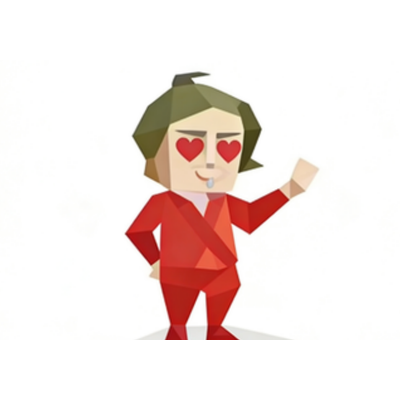
So full of love that reality feels a little barren by comparison.
LOVE-R — The Romantic: Complete SBTI Personality Guide
The Love Chronicle: A Timeline
Age 6 — The Origin Event
You fell in love for the first time. With a sunset, probably. Or a stray cat. Or the way your grandmother hummed while she cooked. Something small and unremarkable to everyone else, and to you, a full-body religious experience. The world cracked open and showed you its soft, glowing center, and you never fully recovered.
This is when the pattern set. Not the pattern of falling in love with people — that came later. The pattern of falling in love with *everything*. Of experiencing the world at a frequency most people can't hear. Of feeling so much, so constantly, that reality itself begins to seem thin — like it can't quite hold the weight of what you're putting into it.
You were six. You didn't have the words for it yet. But the feeling was already there: the world is beautiful, and it is not enough, and I want more of it than it can give me.
Age 14 — First Heartbreak (The Rehearsal)
It wasn't really heartbreak. Not in the adult sense. It was the first time you offered your full, unguarded self to another human being and they responded with something less than the cosmic reciprocity you expected. Maybe they just... didn't text back. Maybe they liked someone else. Maybe they said "you're too intense" and didn't mean it as a compliment.
The wound was real. Disproportionate to the event, maybe, but real. Because you don't do proportional. Your emotional investment is total — once you decide someone's worth it, you go deep. Full bandwidth, no half-measures. At fourteen, you didn't know this was unusual. You assumed everyone felt this way. That everyone composed mental love letters to people they'd spoken to twice. That everyone lay awake at night constructing detailed futures with someone who didn't know their middle name.
They don't. You learned this the hard way, and you've been learning it the hard way ever since.
Age 19 — The Golden Period
Somewhere between late adolescence and early adulthood, there was a window. A bright, reckless, magnificent window where the intensity was an asset. Where being "too much" was attractive instead of alarming. Where your willingness to feel everything — to say it, to write it, to show up with your whole chest every single time — was met with something approaching awe.
You lived at full volume. You wrote letters (real ones, on paper, because you've always understood that the medium is part of the message). You made grand gestures that other people called "romantic" and you called "Tuesday." Your worldview was generous — you leaned toward believing in people, in good intentions, in the fundamental decency of the human experiment.
Your attachment security was low. It always has been. The alarm system was sensitive then, too — a cancelled plan could trigger a full crisis response. But during the golden period, the anxiety was drowned out by the sheer force of how much you were feeling. You were too busy being in love to be afraid of losing it.
Spoiler: you lost it.
Age 23 — The Reckoning
This is the heartbreak that mattered. The one that didn't just crack the surface but went all the way down to the operating system. Not because this person was "the one" — you've believed everyone was the one — but because this time, you finally understood the math: the amount you feel is not the amount you'll receive. The equation doesn't balance. It was never going to balance.
You crave closeness like oxygen. Emotional warmth isn't a preference — it's a survival need. You cling easily and don't mind being clung to. But the person at the center of this reckoning? They needed space. They had boundaries. They were, in retrospect, probably healthy. And your response to healthy boundaries was to interpret them as evidence that you were unlovable, because your self-clarity is low and your inner signal runs on enough static that "they need space" and "they don't love you" sound identical.
You spent months rebuilding. Not the relationship — yourself. You emerged with the same core values intact: growth, meaning, purpose. The conviction that love is the point of the whole exercise didn't waver. It just... grew a bruise.
Age 27 — The Pattern Recognition
By now, you've started to see it. The cycle. The fall, the intensity, the mismatch, the retreat, the rebuild. You see it, and you still can't stop it, because the part of you that falls isn't the part that learns. The learning part is in your head. The falling part is somewhere south of your ribcage, and it doesn't read memos.
Your rules-and-flexibility score is low. You'd rather skip the guidelines and follow your gut, and your gut has exactly one piece of advice: love harder. Even when it hurts. Especially when it hurts. The idea that you should protect yourself — play it cool, guard your heart, wait for reciprocity before investing — registers as morally wrong. To you, restrained love isn't love. It's accounting.
And yet. You're starting to orbit your decisions more carefully. Not landing on them — the Romantic doesn't land, they crash — but at least circling a few more times before impact. There's a growing awareness that the intensity is both your superpower and your vulnerability. That the thing that makes you extraordinary in love is the same thing that makes you devastated by it.
Age 30 — The Chronicle Continues
You're still here. Still feeling everything at a volume that would blow out lesser speakers. Still writing unsent texts that are better than most published poetry. Still believing, against all available evidence, that the next one — the next person, the next sunset, the next song that hits exactly right at exactly the right moment — will be the one that finally matches what you've been carrying.
Your sense of meaning is high. You move with direction. The direction is always the same: toward connection, toward depth, toward the thing that makes your chest ache in a way you've come to understand isn't pain but just... too much love and not enough world.
You read that sentence back. You know it sounds dramatic. You don't care. Drama isn't a flaw. It's a worldview. The Romantic doesn't experience life — they narrate it. Every moment is a chapter, every person is a character, and the story, despite its many plot holes and pacing issues, is worth telling.
So full of love that reality feels a little barren by comparison. That's your tagline. That's your curse. That's also, quietly, your gift.
Dimension Breakdown
Emotional Investment (High) & Boundaries (Low): You go all-in and you crave fusion. Love isn't a part of your life — it's the architecture. This combination makes you the most passionate person in any room and the most likely to need to be scraped off the ceiling after a breakup.
Attachment Security (Low): The alarm is always on. You need constant reassurance not because you're needy (okay, a little because you're needy) but because your inner signal is noisy and silence always sounds like rejection.
Core Values & Sense of Meaning (Both High): Love is your religion, and you practice it devoutly. You run on purpose, and the purpose is connection. This gives your life extraordinary richness and also means you struggle with any period that lacks emotional intensity.
Self-Clarity (Low): You spend a lot of time buffering on the "who am I" screen — especially after a loss. Identity and relationships are deeply intertwined for you; when one destabilizes, so does the other.
Rules & Flexibility (Low): You follow your gut, not the playbook. The "rules of dating" were written for people with functional risk-avoidance systems. Yours is offline.
If You're a LOVE-R
You don't need someone to tell you to "feel less." That's not how you work, and anyone who suggests it doesn't understand the hardware. You were built to feel at this frequency, and the world needs people like you — the ones who refuse to treat love as a transaction.
But here's your growth edge: learn the difference between intensity and intimacy. Intensity is the rush, the drama, the grand gesture, the all-consuming fire. Intimacy is the thing that's left when the fire banks down to coals. You're world-class at intensity. Intimacy — the quiet, consistent, non-cinematic kind — is where you need practice.
Build a relationship with boredom. Not romantic boredom — existential boredom. The kind where nothing is happening and you're not heartbroken and nobody is leaving and there's no crisis to feel your way through. That still place? That's where the real love lives. It's less photogenic. It's more sustainable.
And keep writing the unsent texts. They're better than most published poetry. But maybe, once in a while, hit send.
Dimension Analysis
Your confidence runs on vibes — soaring when things go well, deflating the second the wind changes.
Your inner signal is mostly static. You spend a lot of time buffering on the 'who even am I' loading screen.
Goals, growth, or a deep conviction can light a fire under you pretty easily. You run on purpose.
Your relationship alarm system is hair-trigger sensitive. A 'seen' with no reply and you've already scripted the breakup scene in your head.
Once you decide someone's worth it, you go deep — full emotional bandwidth, no half-measures.
You cling easily and don't mind being clung to. Emotional warmth in a relationship is basically oxygen to you.
You lean toward believing in people and good intentions. When things go wrong, you don't rush to condemn the whole world.
Rules are suggestions you'd rather skip. Comfort and freedom usually outrank compliance.
You move with direction. You generally know which way you're headed, even if the map isn't perfect.
Sometimes you want to win, sometimes you just want to not deal with it. Your motivation is a mixed bag.
You orbit a decision several times before landing. The meeting in your head always runs over.
You can get things done, but it depends on the mood. Sometimes steady, sometimes vibing.
If someone comes to you, great. If not, you're not going to force it. Social flexibility: moderate.
You crave closeness and merging. Once you vibe with someone, they get fast-tracked to the inner circle.
You're skilled at switching personas for different situations. Your authenticity comes in carefully measured doses.
Compatibility

Related Types

Are you a LOVE-R?
Take the SBTI personality test to find out your type.